

We have now entered the agent era, out of the LLM era. Most people are missing this.
Chatbots like ChatGPT and Claude answer questions. You ask, they reply, and the work is still yours to do.
Agents are different. Agents do the work. They draft it, organize it, and bring it back for you to check.
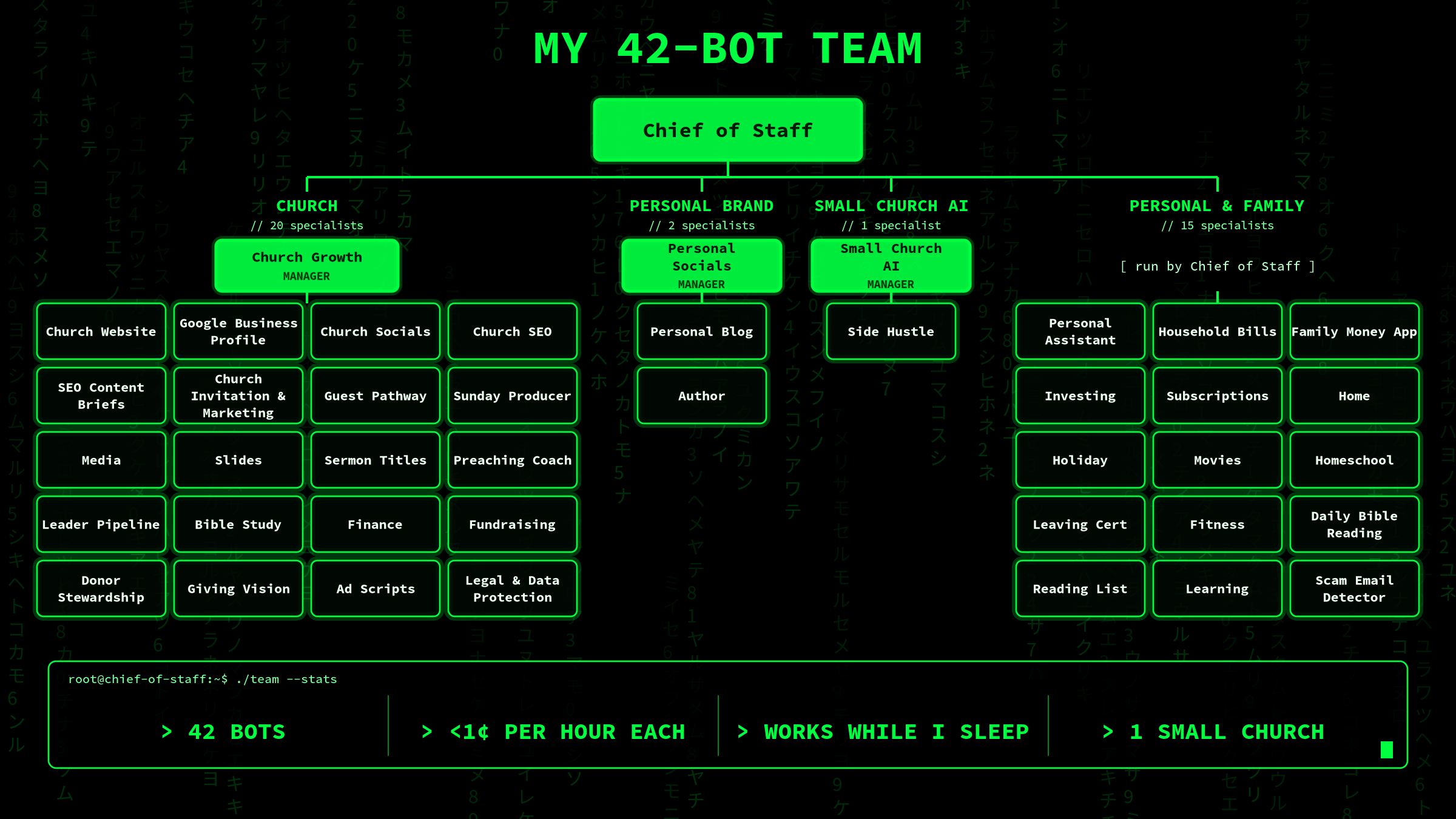
I'm not saying that from theory. I pastor a small church, and I run a team of 42 agents inside Grok Bot. That team is my proof.
And no, not those agents, Neo. Nobody in sunglasses is chasing anyone down a hallway.
These are simple AI agents, each with one job, organized the way a good church staff team is organized.
So here's my advice: don't wait. Start incorporating agents into your workflows now.
There are many use cases, and a small church is full of them.
If you've been wondering whether AI for pastors is real help or just hype, here is how it works for me, what it really costs, and why I think it matters for small churches.
What it costs
I want to be honest about this, because pastors get sold a lot of hype.
The plan is not free. I'm close to my usage limit, so I can't keep piling on work forever.
And the agents don't run the church. They draft. I check, and I approve.
Nothing goes out with my name on it until I've looked at it.
Think of them as eager helpers who are fast at first drafts, not as a replacement for a pastor.
Church admin AI, organized like a staff team
The best decision I made was to set the agents up like a staff team instead of a pile of random chats.
At the top is a chief of staff. By default, that's who I talk to.
It routes the work to the right desk and looks after my personal and family desks directly.
It doesn't do the deep work itself. It hands it off.
Under the chief of staff are managers, one for each area of my life and work:
- Church Growth looks after the church.
- Oz Personal Socials looks after my personal brand.
- Small Church AI looks after this site, X and YouTube.
Under the managers are the specialists. Each one owns one thing. A few examples:
- Website looks after the church website only.
- Google Business Profile looks after our Google listing, its posts and its reviews.
- Socials handles the church's Instagram and Facebook.
- Sermon Titles helps with sermon and series titles.
- Finance helps with the church books.
- Guest Pathway helps with the journey for guests after they visit.
- Side Hustle helps with selling template packs and consulting.
Then there are the personal ones, because a pastor is also a person:
- Household Bills
- Fitness
- Homeschool
- and more
Each agent has a clear lane, and it also knows what is not its job.
- The Website agent doesn't touch the Google listing.
- Finance doesn't handle thanking givers. That's Donor Stewardship.
- When something lands on the wrong desk, it gets handed to its owner.
Twice a week, on Tuesday and Friday, every desk tells the chief of staff what it shipped, what's blocked, and what needs my yes.
Then I get one summary. One. Not 42.
For focused work, I can still talk to a desk directly. That desk still reports back to the chief of staff, so nothing falls through the cracks.
Delegate like you would to a colleague
Working with the agents feels a lot like delegating to a colleague I supervise.
And if you're a pastor, you already know how to do that.
Think about how you lead a volunteer. You don't hand someone the keys and walk away.
You tell them what the job is and what it isn't. Then you check in, see how it went, and say what worked and what to change next time.
It's the same here. I set clear expectations: a role, and the boundaries around it.
When work comes back, I read it and give feedback. The agents remember that feedback, so the next draft is closer to what I want.
What I don't have to do is micromanage. I'm not standing over anyone's shoulder.
I set the lane, check the work, and let them get on with it.
That's good leadership with people, and it turns out it's good leadership with agents, too.
Why plain names matter
We just renamed all the agents to plain function names. "Household Bills." "Sermon Titles." "Guest Pathway."
Boring? Maybe. Useful? Very.
Here's why I'd recommend it to you:
- You know where to go. When a guest needs a follow-up, you don't have to remember which clever nickname handles that. It's Guest Pathway.
- Lanes stay clear. A plain name is a job description. It's much harder for an agent called "Finance" to drift into writing your Instagram captions.
- It's easy to hand over. If a volunteer or co-pastor ever needs to step in, they can read the list and understand it in a minute.
- It shows the gaps. When every agent is named for its job, you can see which jobs nobody owns yet.
Fun names are fine for fun. For a team you rely on, name the work.
What AI for small churches actually gives you
Expertise on tap
Most small churches can't hire a web person, a social media person, a bookkeeper and a guest follow-up coordinator. I can't either.
But I can have a desk that thinks about each of those things and brings me a draft.
That's not the same as an expert on staff. It is a lot more small church help than I had before.
Faster
A first draft that would take me an evening now shows up ready for me to read.
I still edit. I still decide. But I start from something instead of a blank page.
Cheaper
Grok Bot starts at $30 a month, depending on usage.
For a church our size, that's the difference between "we can't afford help" and "we have help."
Multiplying what one pastor can do
There are only so many hours in a week. The agents don't add hours to the day.
They take small, repeatable tasks off the plate so the hours that remain go further.
AI sermon prep: cut sermon prep time and fill the pantry
Here's the real reason I do this.
I believe AI should help cut sermon prep time from about 20 hours a week to about 10.
Not so we can do less. So we can do what matters more.
When the admin, the drafts and the busywork take less time, the pantry gets filled. By that I mean the pastor's own soul.
Time to read. Time to pray. Time to sit with people over coffee and actually listen.
A tired pastor with an empty pantry has nothing to give, and that's how pastor burnout creeps in.
If a team of helpers gives me back hours to be with God and with my people, that's a trade I'll make every time.
Avoiding burnout isn't a luxury for small church pastors. It's how we last.
How to start with one agent
You don't need 42. Start with one.
- Pick one job that drains you. Maybe it's sermon titles. Maybe it's the weekly email. Maybe it's guest follow-up.
- Give it a plain name. Name it for the job: "Weekly Email" or "Guest Follow-Up."
- Write its lane. One or two sentences: what it owns, and what it doesn't.
- Let it draft, and you approve. Don't let it send or post on its own. You check everything.
- Check in weekly. Ask what it did, what's stuck, and what needs your yes.
- Add a second agent only when the first one is earning its keep.
That's it. One desk, one lane, one weekly check-in.
When that works, you'll know what to add next.
Join me
I write about AI for pastors of small churches: what's working, what isn't, and how to use it without losing your soul or your budget.
The agent era is already here, and most people are missing it. Don't be one of them.
Start now with one agent. Pick the job that drains you most, give it a clear lane, and check what comes back.
Then get the free guide at smallchurchai.com. One signup also includes the weekly notes.
Start now with one agent. Fill the pantry.